PACKAGING ENGINEERING
Calculating Corrugated Box Stacking Strength
A practical guide to evaluating packaging compression strength, helping corrugated boxes withstand stacking loads during warehousing, palletizing, transportation, and distribution.
Introduction and Key Concepts
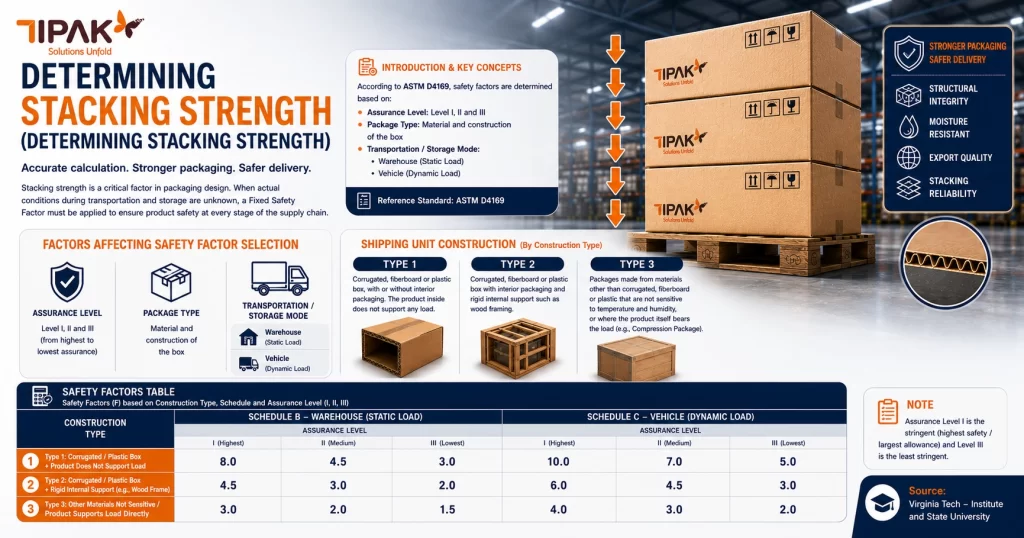
In packaging design, calculating stacking compression strength is an essential step, especially when the exact conditions that packaging may face during transportation and storage are not clearly known.
Applying an appropriate Safety Factor helps improve packaging reliability and reduce the risk of product damage throughout logistics and supply chain operations.
Factors Affecting Safety Factor Selection
🛡️
Assurance Level
The required level of package protection is classified into Level I, II, and III, with Level I being the most stringent and offering the highest safety margin.
📦
Package Type
Packaging materials, box structure, and corrugated board design all influence the ability of the package to withstand compression loads.
🚚
Transport Mode
Storage and transportation conditions, such as warehouse stacking or vehicle movement, affect the type and intensity of compression loads.
Understanding Static Load and Dynamic Load
Warehouse storage generally creates static compression loads, while transportation by vehicle creates dynamic loads involving vibration, movement, acceleration, braking, and impact. Therefore, the selected Safety Factor should match the actual handling and logistics conditions.
Shipping Unit Construction Types
1
Type 1
Corrugated, fiberboard, or plastic packages where the product inside does not contribute to load-bearing capacity.
2
Type 2
Packages with internal packaging or rigid reinforcement, such as wooden structures, that help support compression loads.
3
Type 3
Packages made from other materials, or cases where the product itself directly supports the load.
Safety Factors Table
The following table presents recommended Safety Factors based on package construction type, distribution schedule, and assurance level.
| Package Construction Type |
Schedule B: Warehouse
Static Load |
Schedule C: Vehicle
Dynamic Load |
| Type 1: Corrugated/Fiberboard/Plastic Package + Product Does Not Support Load |
I: 8.0
II: 4.5
III: 3.0 |
I: 10.0
II: 7.0
III: 5.0 |
| Type 2: Corrugated/Fiberboard/Plastic Package + Internal Wooden Support |
I: 4.5
II: 3.0
III: 2.0 |
I: 6.0
II: 4.5
III: 3.0 |
| Type 3: Other Materials or Products That Directly Support Load |
I: 3.0
II: 2.0
III: 1.5 |
I: 4.0
II: 3.0
III: 2.0 |
Note: Assurance Level I is the most stringent level and provides the highest safety margin, while Assurance Level III is the least stringent level.
TIPAK Helps Design Stronger and More Suitable Packaging
We provide professional consultation on corrugated box design, structural selection, and compression strength evaluation to ensure packaging is suitable for storage, transportation, and real operating conditions.
Contact Us